
Guide · 1 October 2026 · 5 min read
What is a defoamer?
By the Accot technical team
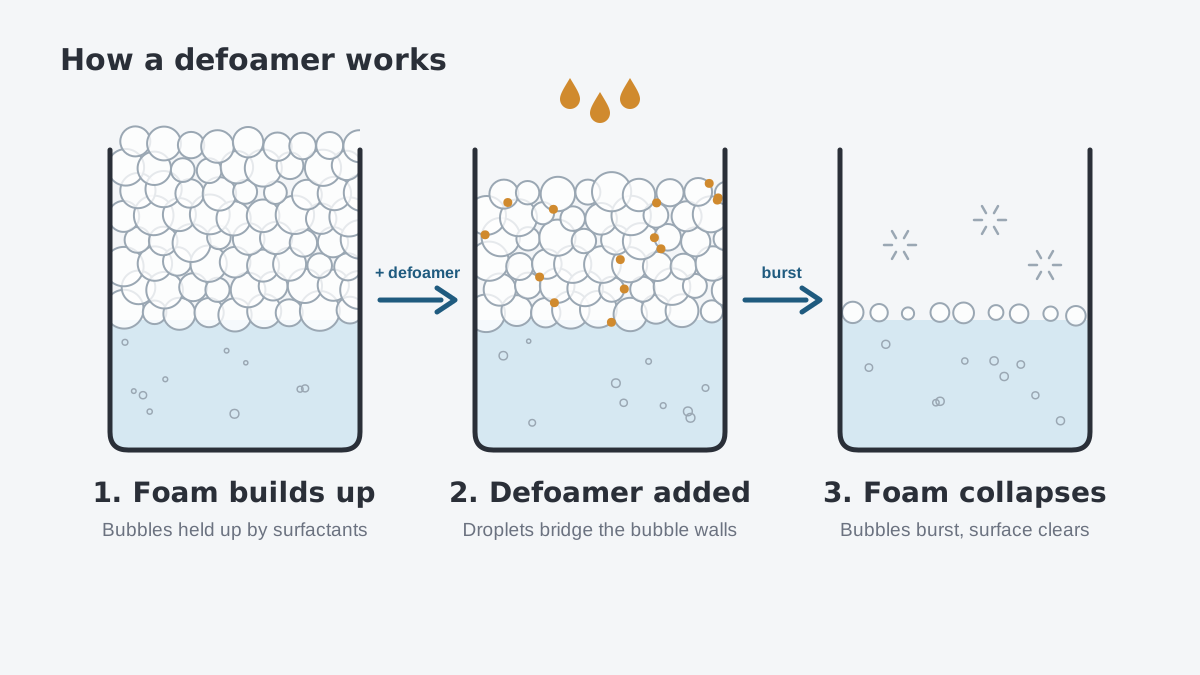
Foam on an aeration basin, clarifier or process tank is more than an eyesore. It floats solids out with the effluent and can spill over onto walkways. A defoamer knocks it down fast, but foam can also be a sign of a deeper problem that a defoamer won’t fix. This guide covers both.
What is a defoamer?
Defoamers, also called antifoams (the two names mean the same thing), are oils, or mixtures of oils with water-repelling (hydrophobic) particles, used to control how much foam forms and how long it lasts.[1]
Foam is just bubbles separated by thin liquid walls, known as foam films. A defoamer forms tiny oil bridges across a foam film, between its two surfaces. Those bridges are unstable, so the film ruptures and the bubble bursts.[1]
Some defoamers work fast, breaking the films early and destroying foam in under a minute in standard foam tests. Others take longer, working over several minutes.[1]
Where are defoamers used?
- Wastewater treatment. Foam builds up on the surface of aeration and clarification tanks,[2] as well as in equalisation tanks and dissolved air flotation (DAF) units.
- Industrial processes. Defoamers are used in industries such as textile, paper and pulp, chemical and other manufacturing.
- Food-related industries. Here, foam is controlled with a silicone-free defoamer.
What problems do defoamers solve?
| Problem | What’s happening |
|---|---|
| Foam overflowing tanks | Heavy foam can spill over the tank and onto walkways.[2] |
| Solids lost with the effluent | Foam floats large amounts of activated sludge solids to the surface, which degrades the effluent.[2] |
| Sudsy white foam that won’t go away | Persistent white foam can come from non-biodegradable substances such as industrial wastes or cleaners.[2] This is the kind of surfactant foam a defoamer breaks down.[1] |
Choosing the right defoamer
The right defoamer depends on what’s causing the foam, your process and its conditions, so our technical team chooses the product and works out the dosage on site.
Our defoamers
Silicone-based
ACCOT Antifoam 9000
Prevents and controls foam in industrial processes and wastewater treatment. Reduces surface tension and breaks down existing foam; effective at low dosage with rapid foam control, and disperses easily in water.
Non-ionic · silicone-free
ACCOT Antispumin GH
Free of mineral and silicone oil, for instant, long-lasting foam removal in food-related industries and wastewater treatment. Works in weak acid and especially alkaline conditions, and does not harm filter units.
Related products
For biological treatment systems we also supply ACCOT Bak-Wira MP 300 and ACCOT NP50. When foam comes from the sludge itself, our technical team looks at the whole biological process, not just the foam.
References
- [1]Denkov, N. D. (2004). Mechanisms of foam destruction by oil-based antifoams. Langmuir, 20(22), 9463–9505. doi.org/10.1021/la049676o
- [2]United States Environmental Protection Agency (1987). Summary Report: The Causes and Control of Activated Sludge Bulking and Foaming (EPA/625/8-87/012). nepis.epa.gov/Exe/ZyPURL.cgi?Dockey=30004EKH.TXT