
Guide · 30 September 2026 · 6 min read
What is a pH adjuster?
By the Accot technical team
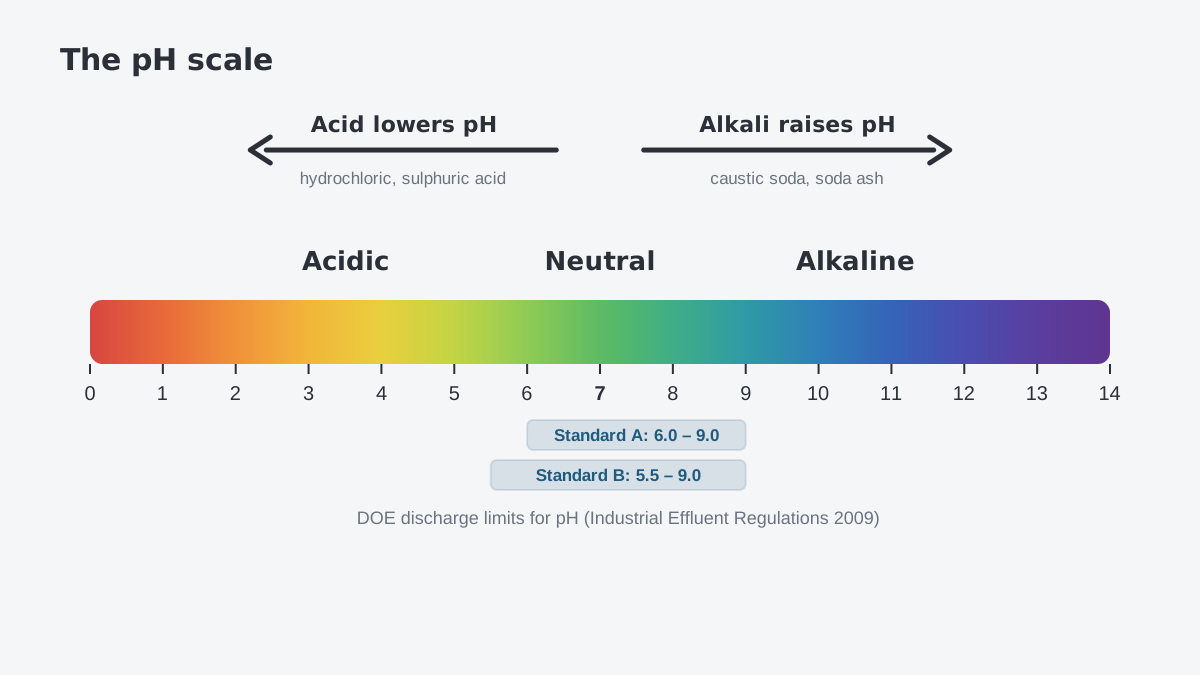
When effluent is too acidic or too alkaline, the effects show up all over the plant. It can fail its discharge limit, stop the coagulant from working, slow down biological treatment, and cause odour and corrosion. Bringing the pH back into range is the job of a pH adjuster. This guide covers what pH actually measures, where pH adjusters are used, and how to choose between them.
What is pH, and what is a pH adjuster?
pH tells you how acidic or basic water is. The scale runs from 0 to 14. Seven is neutral, anything below 7 is acidic, and anything above 7 is basic, or alkaline.[1]
The scale is logarithmic, so each whole number is a ten-fold change: water at pH 5 is ten times more acidic than water at pH 6.[1] A small change in the reading means a big change in the water, which is why pH correction needs careful dosing.
A pH adjuster is simply an acid or an alkali dosed into water to bring its pH into the target range. Alkalis such as caustic soda (sodium hydroxide) and soda ash (sodium carbonate) raise the pH, and a strong mineral acid such as sulphuric acid lowers it.[2]
Where are pH adjusters used?
Any plant that uses acids or alkalis in its process, whether for cleaning, metal pickling, dyeing or chemical processing, can end up with effluent that needs pH correction. The most common uses are:
- Final neutralisation. Effluent is brought within the pH limit of its discharge standard before it leaves the site.[3]
- Before coagulation. Coagulants only work within fairly narrow pH bands. Aluminium and iron coagulants react with the water’s alkalinity and lower its pH, so soft, low-alkalinity water needs alkali added, while high-alkalinity water may need acid.[2]
- Heavy metal removal. Adding alkali turns dissolved metals into insoluble hydroxides that settle. The best pH depends on the metal, so it’s set case by case.[4]
- Biological treatment. Nitrification uses up alkalinity, and as the alkalinity goes, the pH drops.[5]
- Sewers, sumps and tanks. Keeping the pH at or above neutral reduces the hydrogen sulphide gas released into the air above the wastewater.[6]
What problems do pH adjusters solve?
| Problem | How a pH adjuster helps |
|---|---|
| Effluent outside the pH limit | Brings it back into range: pH 6.0–9.0 under Standard A and 5.5–9.0 under Standard B.[3] |
| Poor coagulation, cloudy water | Sets the pH where the coagulant works best. Lowering the pH with acid, instead of adding more coagulant, avoids raising the dissolved metal content of the water.[2] |
| Dissolved heavy metals | Raising the pH precipitates them so they can settle.[4] It matters for toxicity too: metals tend to be more toxic at low pH because they’re more soluble.[1] |
| Nitrification slowing (ammoniacal nitrogen failing) | Keeps pH and alkalinity up. Nitrification and phosphorus removal both slow down when the pH drops below 6.9.[5] |
| Rotten-egg odour, corroded concrete | A pH below 7 favours the formation of dissolved hydrogen sulphide, which escapes as gas. Keeping the pH at or above neutral reduces how much is released.[6] |
You’ll find the full list of Standard A and B discharge limits in our guide What is a coagulant?
Choosing the right pH adjuster
There’s no reliable shortcut for working out the dose. In chemical treatment, the amount needed depends on the pH and alkalinity of the wastewater, and competing reactions make it hard to calculate, so accurate doses should be found by jar tests and confirmed in the field.[4] When coagulation is being tested, the amount of acid or alkali needed is worked out first by titration.[2]
Caustic soda or soda ash?
Both raise the pH, but they behave quite differently. Caustic soda is a strong alkali. It releases hydroxide immediately, so it raises the pH quickly and can push it very high. Soda ash is a milder, buffering alkali: its peak pH is lower, at about 11.5, and its response is more gradual, so you’re less likely to overshoot the target. Handling differs too. Caustic soda is highly corrosive and needs full PPE and trained operators, while soda ash is an irritant and, as a powder, has to be dissolved before dosing.[7]
Whichever you use, concentrated acids and alkalis are corrosive, so always follow the safety data sheet and wear PPE.
Our pH adjusters
Raises pH · alkali
ACCOT Soda Ash
Neutralises acidic water and wastewater and raises pH. Also used to increase the alkalinity of spray booth water. Available as powder or as a 25% solution.
Raises pH · alkali
ACCOT Caustic Soda 50%
50% alkali solution for raising pH and neutralising acidic water and wastewater. High solubility allows easy dosing and rapid reaction.
Lowers pH · acid
ACCOT Hydrochloric Acid 33%
Strong inorganic acid for balancing and neutralising the pH of alkaline water and wastewater, or where acidification is required.
Lowers pH · acid
ACCOT Sulphuric Acid 50%
Strong inorganic acid for lowering pH and reducing alkalinity in water and wastewater, for pH adjustment and neutralisation.
Products that work alongside them
- Our coagulants, ACCOT K101, ACCOT K40FC and ACCOT PAC, each work best within their own pH range. See What is a coagulant?
References
- [1]U.S. Geological Survey. pH and Water, Water Science School. www.usgs.gov/water-science-school/science/ph-and-water
- [2]Environmental Protection Agency, Ireland (2002). Water Treatment Manuals: Coagulation, Flocculation & Clarification. www.epa.ie/publications/compliance--enforcement/drinking-water/advice--guidance/EPA_water_treatment_mgt_coag_flocc_clar2.pdf
- [3]Environmental Quality (Industrial Effluent) Regulations 2009, P.U.(A) 434/2009, made 12 October 2009 under the Environmental Quality Act 1974 — regulation 11 and Fifth Schedule (p. 4031). Department of Environment Malaysia. www.doe.gov.my/wp-content/uploads/2021/08/Environmental_Quality_Industrial_Effluent_Regulations_2009_-_P.U.A_434-2009.pdf
- [4]United States Environmental Protection Agency (2000). Wastewater Technology Fact Sheet: Chemical Precipitation (EPA 832-F-00-018). nepis.epa.gov/Exe/ZyPURL.cgi?Dockey=P1001QTR.TXT
- [5]United States Environmental Protection Agency (2007). Biological Nutrient Removal Processes and Costs (EPA-823-R-07-002). www.epa.gov/sites/default/files/documents/criteria_nutrient_bioremoval.pdf
- [6]United States Environmental Protection Agency (1991). Hydrogen Sulfide Corrosion in Wastewater Collection and Treatment Systems: Report to Congress (430/09-91-009). nepis.epa.gov/Exe/ZyPURL.cgi?Dockey=00000L69.txt
- [7]Aldayyeni, M. Q. & Alameedy, U. (2026). Performance optimization of CO₂ mineralization: a comparative study of caustic soda and soda ash as pH-risers under high-pressure reactor. Iraqi Journal of Chemical and Petroleum Engineering, 27(2), 69–75. doi.org/10.31699/IJCPE.2026.2.6
See it in practice
- Pipe coating plantFluoride removed to well within discharge limitsCase study · Jar test →
- Halal food industrial parkAcidic wastewater neutralised and clearedCase study · Jar test →
- Snack food factoryAcidic, cloudy wastewater prepared for flotationCase study · Jar test →
- Chemical plantStrongly alkaline wastewater neutralised and clearedCase study · Jar test →