
Guide · 30 September 2026 · 6 min read
What is a coagulant?
By the Accot technical team
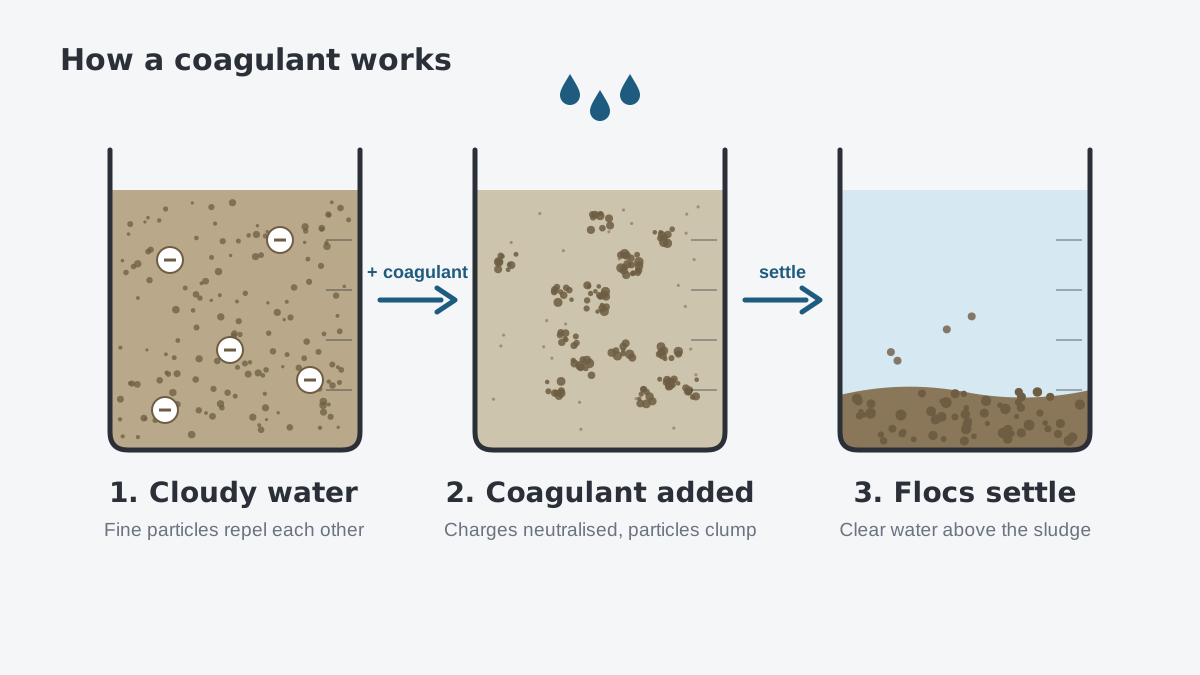
Cloudy clarifier overflow, effluent failing on suspended solids or colour, sludge that just won’t settle: these problems often share the same root cause. The particles in the water are too fine to settle on their own, and a coagulant is what changes that. This guide explains how it works, where it’s used, and how to pick the right one for your plant.
What is a coagulant?
Impurities in water range from coarse to very fine: suspended, colloidal and dissolved.[1] Coarser particles will settle if you give them time. Colloidal particles won’t. They’re so small that they stay suspended for a very long time, and each one carries a negative charge on its surface, so they push each other away, much like two magnets held with the same poles facing.
A coagulant removes that repulsion. Most coagulants are aluminium or iron salts. In water they form positively charged, insoluble hydroxide flocs that neutralise the particles’ negative charge.[1] Once nothing is holding them apart, the particles can finally stick together.
From there, treatment happens in two stages. In coagulation, the chemical is mixed in quickly and thoroughly, and the particles start to clump into tiny micro-flocs. In flocculation, gentle mixing lets those micro-flocs collide and grow into larger, visible flocs, often helped by a polymer flocculant that bridges them into bigger, stronger ones.[1] The flocs are then removed by settling in a clarifier, by dissolved air flotation (DAF) or by filtration.
Common types
Most coagulants belong to one of three families:
- Aluminium-based, such as aluminium sulphate (alum) and polyaluminium chloride (PAC)
- Iron-based, such as ferric chloride and ferric sulphate
- Organic coagulants: cationic polymers such as polyamines, often used alongside an inorganic coagulant
Where are coagulants used?
Anywhere fine particles need to come out of water. The most common places are:
- Drinking water treatment. Coagulants remove turbidity and colour from river and reservoir water before filtration and disinfection.[1]
- Industrial process water. Raw water is clarified before it’s used in the factory.
- Industrial wastewater. Coagulation is either the main physico-chemical treatment step or a polishing step after biological treatment. Typical industries include textile and dyeing, food and beverage, paper and pulp, palm oil, rubber, chemical and petrochemical, metal processing, paint and ink, sugar and starch.
- Oily wastewater. Coagulants help separate fats, oils and grease, often ahead of dissolved air flotation.[2]
- Municipal sewage. They improve solids removal and take out phosphorus.[2]
- Sludge treatment. Sludge is conditioned before it’s thickened and dewatered on belt presses, screw presses, filter presses and decanters.
What problems do coagulants solve?
Most of them come back to the same thing: particles too small to remove on their own.
| Problem | How a coagulant helps |
|---|---|
| Cloudy water, high turbidity or suspended solids | Joins fine particles that would never settle on their own into flocs that settle or float. |
| Coloured effluent | Colour is taken up into the floc and removed with it. Removing colour is one of the main reasons coagulation is used. |
| High COD and BOD | Removes the part of the COD and BOD that is carried by particles, along with the solids. |
| Phosphate | Aluminium and iron salts react with phosphate to form solids that can be removed. |
| Oil and grease | Destabilises fine droplets and particles so they can be separated, for example by flotation. |
| Heavy metals | Helps the very fine particles formed when metals are precipitated by pH adjustment to settle. |
| Poor settling and floc carry-over | Produces stronger, denser flocs that settle faster and leave a clearer overflow. |
Sources: colour and turbidity [1]; phosphate, oil and grease, metals and fine solids [2].
Meeting Malaysian discharge limits
In Malaysia, industrial effluent has to meet the acceptable conditions in the Environmental Quality (Industrial Effluent) Regulations 2009.[3] Which standard applies depends on where you discharge. Standard A covers discharges into inland waters within the catchment areas listed in the Sixth Schedule, which are the areas upstream of water supply intakes used for human consumption, including drinking water. Standard B covers discharges into any other inland or Malaysian waters. The full list of limits is below, with the parameters coagulation directly affects marked ●.
| Item | Parameter | Unit | Standard A | Standard B |
|---|---|---|---|---|
| (i) | Temperature | °C | 40 | 40 |
| (ii) | pH value● | – | 6.0–9.0 | 5.5–9.0 |
| (iii) | BOD₅ at 20 °C● | mg/L | 20 | 50 |
| (iv) | Suspended solids● | mg/L | 50 | 100 |
| (v) | Mercury | mg/L | 0.005 | 0.05 |
| (vi) | Cadmium | mg/L | 0.01 | 0.02 |
| (vii) | Chromium, hexavalent | mg/L | 0.05 | 0.05 |
| (viii) | Chromium, trivalent | mg/L | 0.20 | 1.0 |
| (ix) | Arsenic | mg/L | 0.05 | 0.10 |
| (x) | Cyanide | mg/L | 0.05 | 0.10 |
| (xi) | Lead | mg/L | 0.10 | 0.5 |
| (xii) | Copper | mg/L | 0.20 | 1.0 |
| (xiii) | Manganese | mg/L | 0.20 | 1.0 |
| (xiv) | Nickel | mg/L | 0.20 | 1.0 |
| (xv) | Tin | mg/L | 0.20 | 1.0 |
| (xvi) | Zinc | mg/L | 2.0 | 2.0 |
| (xvii) | Boron | mg/L | 1.0 | 4.0 |
| (xviii) | Iron (Fe)● | mg/L | 1.0 | 5.0 |
| (xix) | Silver | mg/L | 0.1 | 1.0 |
| (xx) | Aluminium● | mg/L | 10 | 15 |
| (xxi) | Selenium | mg/L | 0.02 | 0.5 |
| (xxii) | Barium | mg/L | 1.0 | 2.0 |
| (xxiii) | Fluoride | mg/L | 2.0 | 5.0 |
| (xxiv) | Formaldehyde | mg/L | 1.0 | 2.0 |
| (xxv) | Phenol | mg/L | 0.001 | 1.0 |
| (xxvi) | Free chlorine | mg/L | 1.0 | 2.0 |
| (xxvii) | Sulphide | mg/L | 0.50 | 0.50 |
| (xxviii) | Oil and grease● | mg/L | 1.0 | 10 |
| (xxix) | Ammoniacal nitrogen | mg/L | 10 | 20 |
| (xxx) | Colour● | ADMI* | 100 | 200 |
*ADMI: American Dye Manufacturers Institute (colour units).
Regulation 11 adds two more rules. Where two or more of the metals (xii) to (xvi) are present, their total must not exceed 0.5 mg/L under Standard A, or 3.0 mg/L in total and 1.0 mg/L in soluble form under Standard B. And where Standard B applies and both phenol and free chlorine are present, phenol must not exceed 0.2 mg/L and free chlorine 1 mg/L.[3]
Chemical oxygen demand (COD) limits are set separately for each trade or industry, under regulation 12 and the Seventh Schedule. Some sectors also have their own regulations, so check the limits that apply to your premises with the Department of Environment.
Aluminium and iron are on that list too, which is a reminder that the coagulant itself has to be dosed correctly. Too little leaves the water cloudy. Too much wastes chemical, lowers the pH and can leave residual aluminium or iron in the treated water.[1]
Choosing the right coagulant
No two waters are the same. Each coagulant works best within its own pH range and at the right dose, and both depend on the water you’re treating.[1] That’s why the choice comes down to the jar test: samples of your actual water are treated side by side with different coagulants and doses, and the results are compared. EPA Ireland’s treatment manual calls it probably the most important routine test at a plant that uses coagulation.[1]
Our coagulants
Aluminium-based liquid
ACCOT K101
Specially formulated basic aluminium salt with stronger coagulation and flocculation than standard aluminium and iron salts. Forms strong flocs that settle quickly, with sludge that is easier to filter and lower in volume.
Ferric-based
ACCOT K40FC
Efficient, chemically stable ferric coagulant for drinking water, industrial water, industrial wastewater, municipal sewage and sludge dewatering.
Polyaluminium chloride
ACCOT PAC
Strong coagulating and flocculating properties that work across a wide pH range. Liquid, easy to handle and dilute for automated dosing.
Products that work alongside them
- ACCOT Anionic Polymer, a flocculant aid added after the coagulant for larger, faster-settling flocs.
- ACCOT Cationic Polymer, for thickening and dewatering the sludge that coagulation produces.
- ACCOT Non-ionic Polymer, for oily or fatty wastewater and mineral suspensions.
- pH adjusters, to keep coagulation in its best pH range: Soda Ash or Caustic Soda 50% to raise it, Hydrochloric Acid 33% or Sulphuric Acid 50% to lower it. See What is a pH adjuster?
References
- [1]Environmental Protection Agency, Ireland (2002). Water Treatment Manuals: Coagulation, Flocculation & Clarification. www.epa.ie/publications/compliance--enforcement/drinking-water/advice--guidance/EPA_water_treatment_mgt_coag_flocc_clar2.pdf
- [2]United States Environmental Protection Agency (2000). Wastewater Technology Fact Sheet: Chemical Precipitation (EPA 832-F-00-018). nepis.epa.gov/Exe/ZyPURL.cgi?Dockey=P1001QTR.TXT
- [3]Environmental Quality (Industrial Effluent) Regulations 2009, P.U.(A) 434/2009, made 12 October 2009 under the Environmental Quality Act 1974 — regulation 11, Fifth Schedule (p. 4031) and Sixth Schedule (p. 4032). Department of Environment Malaysia. www.doe.gov.my/wp-content/uploads/2021/08/Environmental_Quality_Industrial_Effluent_Regulations_2009_-_P.U.A_434-2009.pdf
Further reading
- Jiang, J.-Q. (2015). The role of coagulation in water treatment. Current Opinion in Chemical Engineering, 8, 36–44. doi.org/10.1016/j.coche.2015.01.008
See it in practice
- Pipe coating plantFluoride removed to well within discharge limitsCase study · Jar test →
- Silica sand processing plantFluoride cut by 96% in pickling-plant wastewaterCase study · Jar test →
- Rubber latex processing plantMilky latex wastewater cleared to under 2 NTUCase study · Jar test →
- Aircraft maintenance facilityCloudy wastewater cleared to under 1 NTUCase study · Jar test →