
Guide · 30 September 2026 · 6 min read
What is a flocculant?
By the Accot technical team
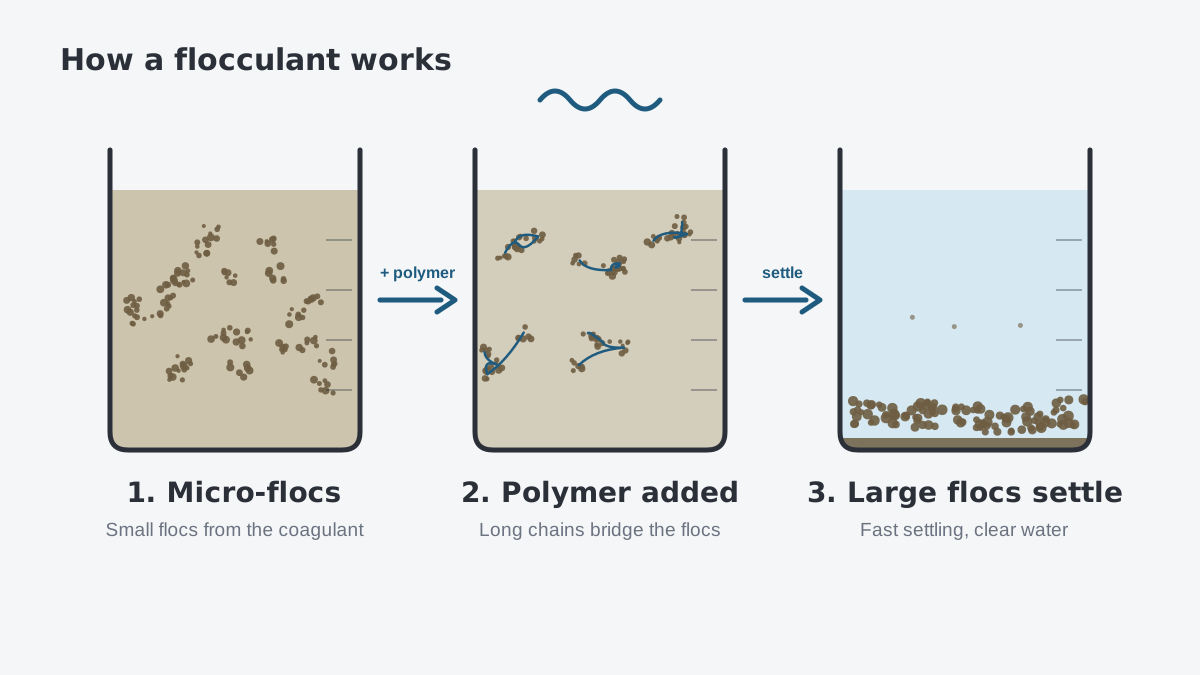
A coagulant gets fine particles to clump into micro-flocs, but those micro-flocs are often still too small to settle quickly or dewater well. A flocculant takes them the rest of the way, growing them into large, strong flocs. This guide explains how flocculants work, where they’re used, and how to get the best out of them.
What is a flocculant?
The flocculants used in water treatment are polymers, also known as polyelectrolytes. They’re long-chain organic molecules with chemical groups along the chain that become charged once the polymer dissolves in water.[1] Those groups decide which type a polymer is:
- Cationic: positively charged
- Anionic: negatively charged
- Non-ionic: no charge
- Amphoteric: both positive and negative charges[1]
Whatever the type, the job is the same: bringing small particles together into larger clumps. A flocculant can work as an aid alongside an aluminium or iron coagulant, making it more effective, and in special cases it can act as the main (primary) coagulant itself.[1] Its long chains act as bridges between particles, gathering them into large flocs that settle.[2]
Where are flocculants used?
- Clarification. After the coagulant, a flocculant grows flocs that settle in a clarifier or float in a dissolved air flotation (DAF) unit.[1]
- Heavy metal removal. Once the pH has been set to precipitate the metals, a polymer gathers the fine metal particles into a coarse floc that settles quickly.[2] See What is a pH adjuster?
- Oily wastewater. A polymer that neutralises the charges holding oil droplets apart helps break the emulsion, so the oil can separate.[2]
- Sludge thickening and dewatering. Every belt filter press has a polymer conditioning zone,[3] and sludge fed to a centrifuge must be conditioned with polymer for the best performance.[4] Dewatering shrinks the sludge volume, which cuts storage and transport costs.[3]
What problems do flocculants solve?
| Problem | How a flocculant helps |
|---|---|
| Fine floc that won’t settle, cloudy overflow | Bridges micro-flocs into larger clumps that settle quickly.[1][2] |
| Suspended solids above the discharge limit | Captures more of the solids, helping you meet the limit of 50 mg/L under Standard A or 100 mg/L under Standard B.[5] |
| Wet sludge cake, high disposal cost | Conditions the sludge so belt presses and centrifuges can release more water.[3][4] |
| High coagulant use, large sludge volume | As a flocculant aid, it makes the coagulant more effective, and replacing part of the inorganic coagulant with polymer reduces the mass of sludge to dispose of.[1] |
Choosing and using a flocculant
The right charge and grade depend on your particles and your process, so the choice is made by testing on your actual water or sludge. Accurate doses of treatment chemicals should be found by jar tests and confirmed in the field.[2]
Getting the best from a flocculant
- Dose it after the coagulant. Leave one to several minutes for micro-flocs to form before the polymer goes in.[1]
- Dilute it first. Polymer solutions are extremely viscous, and dilute solutions spread through the flow much more easily.[1] Make-up systems need enough mixing and aging capacity.[4]
- Mix well at the dosing point, gently afterwards. You need rapid, thorough mixing where the polymer goes in,[1] but turbulence after that shears the floc and wastes polymer.[4]
- Store it properly. Powders normally keep for 12 months if they’re kept dry, while liquids and emulsions usually last 4 to 12 months if protected from frost.[1] And watch out for spills: spilled polymer is very slippery.
Our flocculants
Anionic · powder or emulsion
ACCOT Anionic Polymer
Very high molecular weight polyacrylamide for clarification of raw water and industrial effluents, mineral slurries and process waters. Used as a flocculant aid after the coagulant.
Cationic · powder or emulsion
ACCOT Cationic Polymer
Very high molecular weight polyacrylamide for wastewater purification and for thickening and dewatering sludge on belt presses, screw presses, centrifuges and filter presses.
Non-ionic · emulsion
ACCOT Non-ionic Polymer
For sludge dewatering, water clarification and mineral suspensions. Works particularly well in oily or fatty waters where surface charges are suppressed.
Products that work alongside them
- Our coagulants, ACCOT K101, ACCOT K40FC and ACCOT PAC, are dosed before the flocculant.
- pH adjusters set the pH for coagulation and metal precipitation. See What is a pH adjuster?
References
- [1]Environmental Protection Agency, Ireland (2002). Water Treatment Manuals: Coagulation, Flocculation & Clarification. www.epa.ie/publications/compliance--enforcement/drinking-water/advice--guidance/EPA_water_treatment_mgt_coag_flocc_clar2.pdf
- [2]United States Environmental Protection Agency (2000). Wastewater Technology Fact Sheet: Chemical Precipitation (EPA 832-F-00-018). nepis.epa.gov/Exe/ZyPURL.cgi?Dockey=P1001QTR.TXT
- [3]United States Environmental Protection Agency (2000). Biosolids Technology Fact Sheet: Belt Filter Press (EPA 832-F-00-057). www.epa.gov/sites/default/files/2018-11/documents/belt-filter-press-factsheet.pdf
- [4]United States Environmental Protection Agency (2000). Biosolids Technology Fact Sheet: Centrifuge Thickening and Dewatering (EPA 832-F-00-053). www.epa.gov/sites/default/files/2018-11/documents/centrifuge-thickening-dewatering-factsheet.pdf
- [5]Environmental Quality (Industrial Effluent) Regulations 2009, P.U.(A) 434/2009, made 12 October 2009 under the Environmental Quality Act 1974 — Fifth Schedule (p. 4031). Department of Environment Malaysia. www.doe.gov.my/wp-content/uploads/2021/08/Environmental_Quality_Industrial_Effluent_Regulations_2009_-_P.U.A_434-2009.pdf
See it in practice
- Rubber latex processing plantMilky latex wastewater cleared to under 2 NTUCase study · Jar test →
- Snack food factoryAcidic, cloudy wastewater prepared for flotationCase study · Jar test →
- Semiconductor plantSlurry that presses easily, with clear filtrateCase study · Jar test →