
Guide · 1 October 2026 · 5 min read
What is a disinfectant?
By the Accot technical team
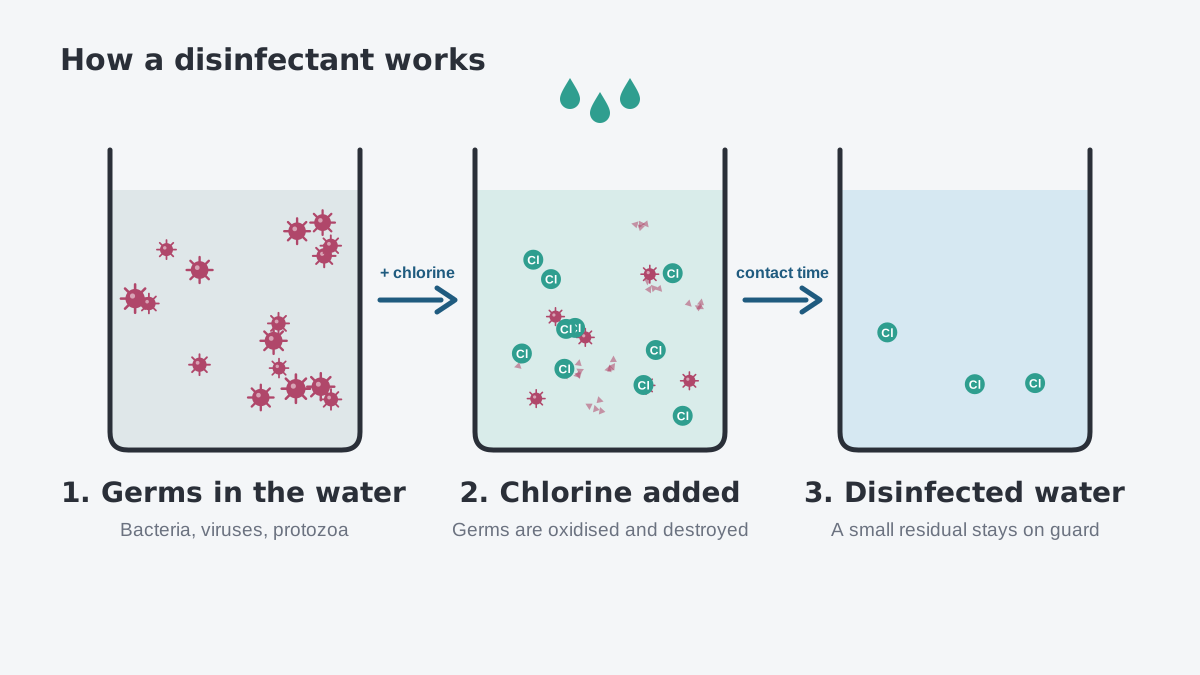
Water can look perfectly clear and still carry germs. Disinfection is the step that deals with them, and chlorine is still the most widely used way of doing it. This guide explains how chlorine disinfects, where it’s used, and the few things to get right so it works without causing new problems.
What is a disinfectant?
A disinfectant destroys or inactivates the organisms that cause disease. Untreated wastewater, for example, can carry harmful bacteria such as E. coli, Salmonella and the cholera bacterium, as well as viruses and protozoa such as Giardia.[1]
Chlorine is the most widely used disinfectant for municipal wastewater. It destroys organisms by oxidising their cell material. It comes as chlorine gas, as hypochlorite solutions like ours, and in solid form; the main alternatives are ozone and ultraviolet (UV) light.[1]
Once in the water, chlorine and hypochlorite form hypochlorous acid and hypochlorite ions, together known as free available chlorine. The chlorine that remains afterwards, called the residual, keeps disinfecting after the initial treatment, and it can be measured to check that disinfection is working.[1]
Where are disinfectants used?
- Raw water for industry. Factories that draw water from a river, such as sugar mills, disinfect it to kill bacteria before it’s used on site.
- Cooling towers. Hypochlorite is also used to treat cooling tower water.
- Drinking water. WHO’s guidance for effective disinfection is at least 0.5 mg/L of free chlorine after at least 30 minutes of contact, at a pH below 8, with at least 0.2 mg/L still present where the water is delivered.[2]
- Treated wastewater. Effluent is disinfected to destroy pathogens before it’s discharged.[1]
What problems do disinfectants solve?
Chlorine does two useful jobs:
- It kills germs. Bacteria, viruses and protozoa are destroyed by oxidation.[1]
- It can remove some odours. Chlorine can eliminate certain unpleasant odours during disinfection.[1]
What to watch out for
Getting the most from chlorine means keeping an eye on a few things:
| Watch for | Why it matters |
|---|---|
| Too much chlorine at discharge | There’s a maximum as well as a minimum. Free chlorine in industrial effluent is limited to 1.0 mg/L under Standard A and 2.0 mg/L under Standard B.[3] Even low residuals are toxic to aquatic life, so treated effluent may need dechlorinating before it’s released.[1] |
| Dirty water | Disinfection only works well on water that has been treated properly first. Suspended solids shield bacteria from the chlorine, and water full of chlorine-demanding material uses it up, so it needs higher doses.[1] |
| By-products | Chlorine reacts with some organic matter to form more hazardous compounds, such as trihalomethanes.[1] |
| Tough parasites | Some parasites, including Cryptosporidium, Giardia and the eggs of parasitic worms, can survive low doses of chlorine.[1] |
Choosing and using a disinfectant
The right dose depends on the water: how much chlorine it uses up, how much ammonia it carries, its pH and its solids.[1] Contact time and pH decide how well the chlorine works,[2] and it needs very fast, thorough mixing where it’s dosed.[1] All of this is why the dose is worked out by testing on your water.
Handling it safely
- All forms of chlorine are highly corrosive and toxic, so storage and handling need care.[1]
- Never mix hypochlorite with acids: it releases chlorine gas. Store it in a cool, shaded place away from sunlight, and wear protective gear when handling it.
Our disinfectant
Chlorine-based · liquid
ACCOT Sodium Hypochlorite 10%
Clear, pale yellow liquid with 10% available chlorine. Fast-acting against a broad range of microorganisms, and an economical choice for disinfecting water, for example river water drawn for use in a factory, and for cooling tower treatment. Available in 25 kg and 1,000 kg containers.
Related guides
- Removing solids before disinfection makes chlorine work far better. See What is a coagulant?
References
- [1]United States Environmental Protection Agency (1999). Wastewater Technology Fact Sheet: Chlorine Disinfection (EPA 832-F-99-062). nepis.epa.gov/Exe/ZyPDF.cgi/200044E0.PDF?Dockey=200044E0.PDF
- [2]World Health Organization (2017). Guidelines for Drinking-water Quality, fourth edition incorporating the first addendum, Annex 3, Table A3.3. cdn.who.int/media/docs/default-source/wash-documents/water-safety-and-quality/dwq-guidelines-4/gdwq4-with-add1-annex3.pdf
- [3]Environmental Quality (Industrial Effluent) Regulations 2009, P.U.(A) 434/2009, made 12 October 2009 under the Environmental Quality Act 1974 — Fifth Schedule (p. 4031). Department of Environment Malaysia. www.doe.gov.my/wp-content/uploads/2021/08/Environmental_Quality_Industrial_Effluent_Regulations_2009_-_P.U.A_434-2009.pdf