
Guide · 6 October 2026 · 5 min read
What is activated carbon?
By the Accot technical team
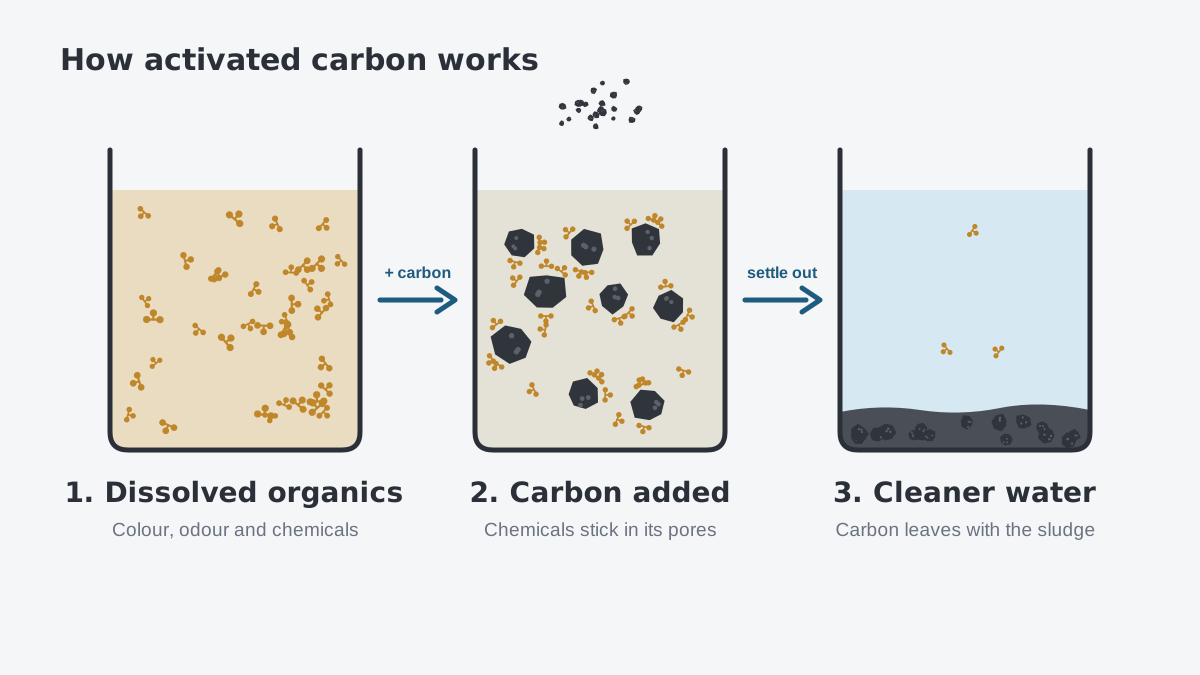
Some of what’s in water won’t settle out or float off, because it’s dissolved: colour, odours and traces of chemicals such as solvents and pesticides. Activated carbon is one of the main ways to take them out. This guide explains what it is, how it works, what it removes, and how to choose between powder and granules.
What is activated carbon?
Activated carbon is made by heating carbon-rich material, normally wood, coal, coconut shells or peat, under controlled conditions. This “activation” leaves a very porous material with a huge surface area, 500 to 1,500 square metres in every gram, and a strong attraction to organic compounds.[1]
It works by adsorption: molecules in the water stick to the inside walls of the carbon’s pores.[2] It’s normally used in one of two forms, as a powder or as granules.[1]
Where is activated carbon used?
- Wastewater. Activated carbon is used for advanced (tertiary) treatment of municipal and industrial wastewater, to take out the small amounts of dissolved organics left after biological or chemical treatment.[2]
- Drinking water. It removes pesticides and other organic chemicals, taste and odour compounds, and toxins from blue-green algae.[1]
Where it sits in a plant depends on the form. Powder is usually dosed during coagulation,[1] while a bed of granules usually comes after filtration and before disinfection.[2]
What problems does it solve?
Activated carbon deals with what other steps miss: dissolved organic chemicals. The US Environmental Protection Agency lists the kinds of organic compounds that carbon adsorbs well, including:[2]
| Problem | Examples |
|---|---|
| Colour | Soluble organic dyes, such as textile dyes |
| Phenols | Phenol, cresol, chlorophenols |
| Solvents | Benzene, toluene, xylene, and chlorinated solvents such as perchloroethylene |
| Fuels and oil | Petrol, kerosene, oil |
| Detergents | Surfactants such as alkyl benzene sulphonates |
| Pesticides | 2,4-D, atrazine, carbofuran |
In wastewater it can also take out small amounts of some inorganic compounds, such as sulphides and heavy metals.[2]
What to watch out for
Carbon only has so much room in its pores, so it pays to look after it:
| Watch for | Why it matters |
|---|---|
| Other organics | Background organic matter in the water greatly reduces how much of the target chemical the carbon can hold.[1] |
| Solids | A bed of granules needs steady, well-treated water, with suspended solids below 20 mg/L and no surges in flow. Solids and high BOD can both hold back adsorption.[2] |
| pH and temperature | Both change how soluble the contaminants are, and so how well they adsorb.[2] |
| Spent carbon | Once its capacity is used up, carbon stops working and has to be replaced or reactivated.[1] Spent carbon that isn’t reactivated has to be disposed of.[2] |
Powder or granules?
The choice comes down to cost-effectiveness, and to how often and how much carbon is needed.[1]
| Powdered activated carbon | Granular activated carbon | |
|---|---|---|
| How it’s used | Mixed into the water as a slurry, often during coagulation[1] | Packed in a bed that the water flows through[1] |
| How it’s removed | Caught in the floc and taken out with the sludge[1] | Stays in the bed until it’s spent, then is taken out and replaced[2] |
| Reuse | Normally used once[1] | Can be reactivated by burning off what it has adsorbed[1] |
| Best for | Seasonal or occasional problems, or where only small doses are needed[1] | Getting the most from the carbon: a bed uses it much more efficiently than dosing powder[1] |
Related guides
- Carbon works best on water that has already had its solids removed. See What is a coagulant?
- In wastewater, carbon usually polishes what’s left after biological treatment. See What is biological treatment?
References
- [1]World Health Organization (2017). Guidelines for Drinking-water Quality, fourth edition incorporating the first addendum, Annex 5: Treatment methods and performance, section A5.1.7. cdn.who.int/media/docs/default-source/wash-documents/water-safety-and-quality/dwq-guidelines-4/gdwq4-with-add1-annex5.pdf
- [2]United States Environmental Protection Agency (2000). Wastewater Technology Fact Sheet: Granular Activated Carbon Adsorption and Regeneration (EPA 832-F-00-017). kh.aquaenergyexpo.com/wp-content/uploads/2022/11/Wastewater-Technology-Fact-Sheet-Granular-Activated-Carbon-Adsorption-and-Regeneration.pdf