
Guide · 1 October 2026 · 6 min read
What is biological treatment?
By the Accot technical team
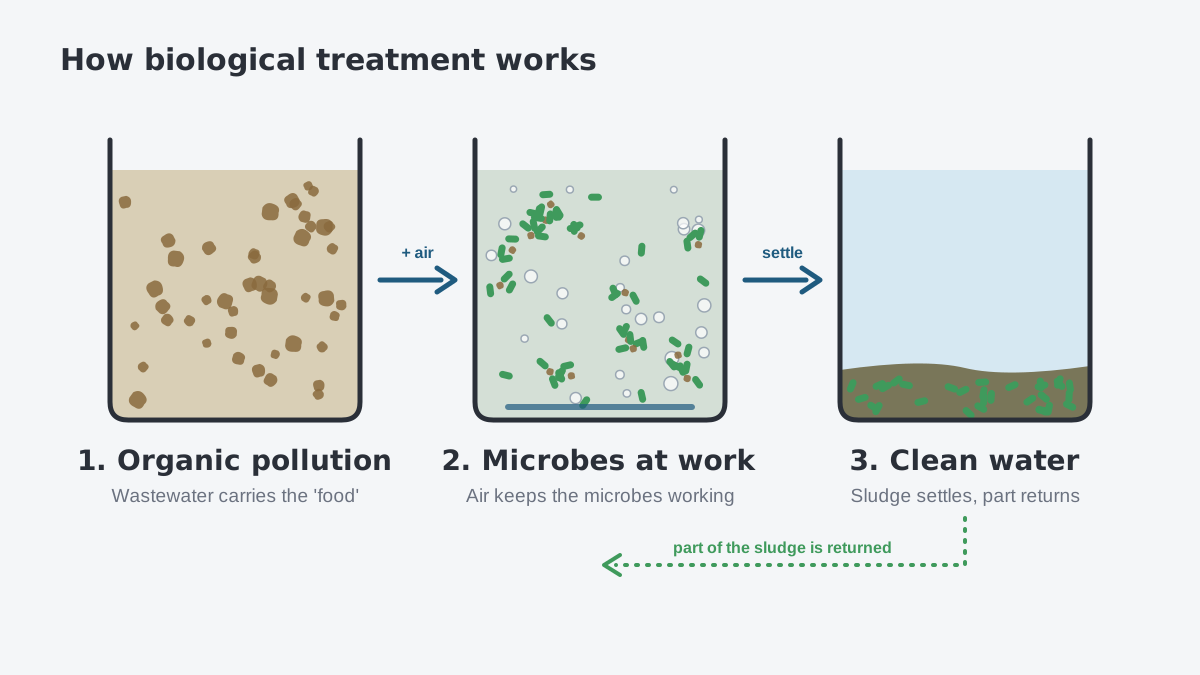
Most wastewater is cleaned by living things: bacteria and other microbes that feed on the organic pollution. Biological treatment is the process that puts them to work. Our products don’t replace that process. They keep the microbes topped up, fed and working well, and that’s what this guide is about.
What is biological treatment?
Nature already breaks down organic waste; a treatment plant just speeds it up. When oxygen is added to wastewater, masses of microorganisms grow and rapidly break down the organic pollutants, and the extra growth is then removed by settling.[1] Done well, this biological (or “secondary”) treatment can remove up to 90 percent of the organic matter in wastewater.[1]
There are a few common ways of doing it:
- Activated sludge. The microbes are mixed with the wastewater in an aerated tank, then settled out in a clarifier. Part of the settled sludge is returned to the tank to keep the population going, and the rest is removed.[1]
- Attached growth. The microbes grow on stone or plastic media, as in trickling filters and rotating biological contactors.[1]
- Lagoons and ponds. Sunlight, algae, bacteria and oxygen work together in a shallow pond.[1]
- Aerobic or anaerobic. Aerobic processes need oxygen; anaerobic ones work without it. Anaerobic digestion has the added benefit of producing methane, which can be recovered as energy.[1]
Where is biological treatment used?
- Municipal sewage plants. Biological treatment is the standard “secondary treatment” step.[1]
- Industrial wastewater with a high organic load, for example from food and beverage, palm oil and rubber processing.
What problems does it solve?
| Problem | How biological treatment helps |
|---|---|
| High BOD and COD | The microbes consume the organic pollution.[1] The BOD limit is 20 mg/L under Standard A and 50 mg/L under Standard B.[2] |
| Ammoniacal nitrogen | In the presence of oxygen, nitrification converts ammonia to nitrite and nitrate.[3] The limit is 10 mg/L under Standard A and 20 mg/L under Standard B.[2] |
| Odour | A properly operated activated sludge plant is generally free of flies and odours.[1] |
Keeping the microbes healthy
When a biological plant struggles, the cause is usually one of these:
| What they need | Why it matters |
|---|---|
| Nutrients | There are generally enough nutrients when BOD, nitrogen and phosphorus are in a ratio of about 100 : 5 : 1, and missing nutrients should be added. Nutrient-poor wastewater can lead to sludge bulking, where the sludge won’t settle.[3] |
| Oxygen | At least 0.5 mg/L of dissolved oxygen should be kept in the aeration tank. Low oxygen encourages the filamentous bacteria that cause bulking.[3] |
| The right pH | Treatment works well between pH 6.0 and 9.0.[3] Nitrification uses up alkalinity, and both nitrification and phosphorus removal slow down when the pH drops below 6.9.[4] See What is a pH adjuster? |
| Fresh, not septic, wastewater | Septic (stale) wastewater encourages filamentous bacteria that cause bulking.[3] |
How we support biological treatment
Topping up the microbes
Adding a culture of bacteria to a plant is called bioaugmentation: specific pollutant-degrading microorganisms are added to strengthen the microbes already there.[5] Results have been encouraging, but it doesn’t always work. Added microbes can die off if conditions are poor, for example from too little food, unsuitable temperature or pH, a lack of nutrients, competition with the existing microbes or shock loads, and low doses can simply wash out.[5]
That’s why our bacteria culture is seeded on a regular programme rather than as a one-off, and why it works best alongside the right nutrients, oxygen and pH.
Our biological treatment products
Bacteria culture · bioaugmentation
ACCOT Bak-Wira MP 300
Live blend of bacteria and enzymes selected to degrade a wide range of organic wastes, including oil and grease, proteins and carbohydrates. Seeded regularly to maintain a healthy population; also used for start-up and recovery after upsets.
Micronutrients
ACCOT NP50
Liquid trace nutrients and micronutrients that give the microbes a balanced diet, in both aerobic and anaerobic treatment.
Nitrogen source
ACCOT Urea
46% nitrogen, industrial grade, for balancing the nutrient ratio in activated sludge systems and denitrification units.
Phosphorus source
ACCOT Trisodium Phosphate
Phosphate source for balancing the nutrient ratio, complementing urea as the nitrogen source.
Odour control
ACCOT ST 300RL
Non-hazardous liquid that eliminates and neutralises odour at source from wastewater, sludge and compost.
Related guides
- Foam on an aeration tank can come from the biological process itself. See What is a defoamer?
- Keeping the pH and alkalinity right is covered in What is a pH adjuster?
References
- [1]United States Environmental Protection Agency (2004). Primer for Municipal Wastewater Treatment Systems (EPA 832-R-04-001). www.epa.gov/sites/default/files/2015-09/documents/primer.pdf
- [2]Environmental Quality (Industrial Effluent) Regulations 2009, P.U.(A) 434/2009, made 12 October 2009 under the Environmental Quality Act 1974 — Fifth Schedule (p. 4031). Department of Environment Malaysia. www.doe.gov.my/wp-content/uploads/2021/08/Environmental_Quality_Industrial_Effluent_Regulations_2009_-_P.U.A_434-2009.pdf
- [3]United States Environmental Protection Agency (1987). Summary Report: The Causes and Control of Activated Sludge Bulking and Foaming (EPA/625/8-87/012). nepis.epa.gov/Exe/ZyPURL.cgi?Dockey=30004EKH.TXT
- [4]United States Environmental Protection Agency (2007). Biological Nutrient Removal Processes and Costs (EPA-823-R-07-002). www.epa.gov/sites/default/files/documents/criteria_nutrient_bioremoval.pdf
- [5]Nzila, A., Razzak, S. A. & Zhu, J. (2016). Bioaugmentation: an emerging strategy of industrial wastewater treatment for reuse and discharge. International Journal of Environmental Research and Public Health, 13(9), 846. doi.org/10.3390/ijerph13090846