
Guide · 6 October 2026 · 6 min read
What is an oxidiser?
By the Accot technical team
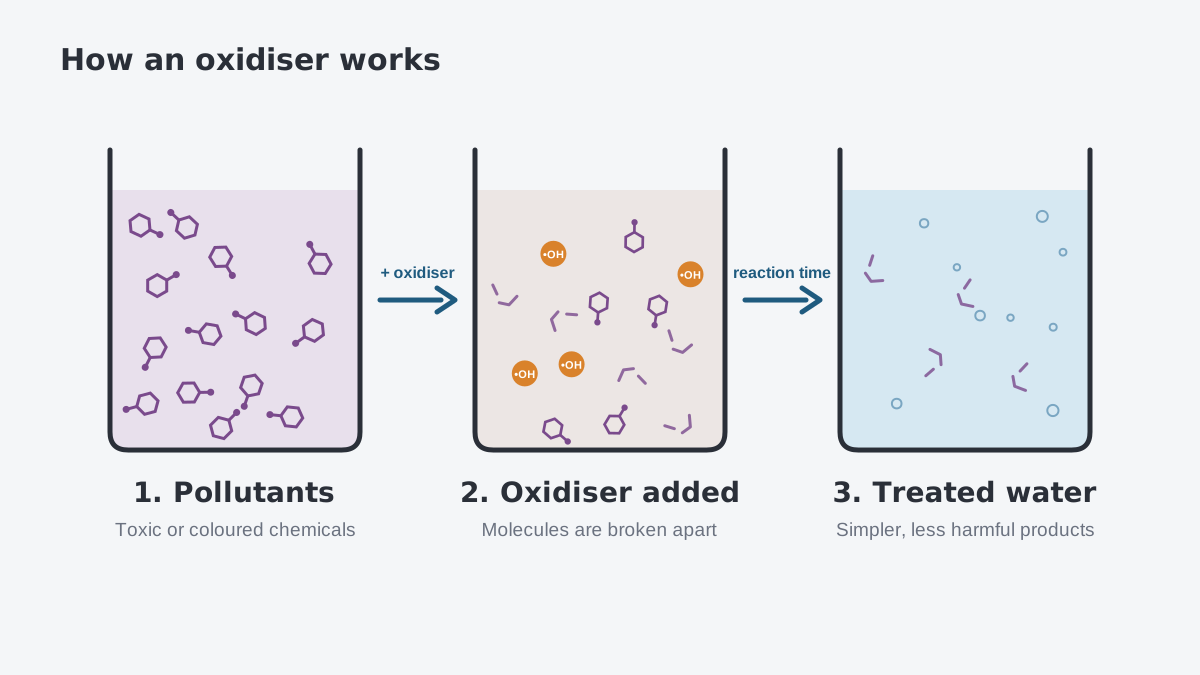
Some pollutants won’t settle out, filter off or break down easily on their own: cyanide, phenol, some dyes, and the chelating agents that hold metals in solution. An oxidiser breaks them down chemically. This guide explains how oxidisers work, where they’re used, and what to watch for.
What is an oxidiser?
An oxidiser is a chemical that reacts with a pollutant and breaks it down, or converts it into a form that is less harmful or easier to remove. Common oxidisers in water treatment include chlorine and hypochlorite, hydrogen peroxide and ozone.[3] Chlorine, for example, is mainly used to disinfect, but it also acts as an oxidant: it can break down some pesticides and turn dissolved manganese into a solid that can be filtered out.[3]
Some oxidisers are much stronger than others. Compared with chlorine:
| Oxidiser | Relative power |
|---|---|
| Hydroxyl radical (made in Fenton's reagent) | 2.06 |
| Hydrogen peroxide | 1.31 |
| Permanganate | 1.24 |
| Chlorine dioxide | 1.15 |
| Hypochlorous acid (from hypochlorite) | 1.10 |
| Chlorine | 1.00 |
Where are oxidisers used?
- Chemical and process industries. Fenton’s reagent is used on wastewater from making chemicals, pharmaceuticals, pesticides, dyes and inks, from plastics and adhesives manufacture, paint stripping, and refinery phenol streams.[1]
- Cyanide wastewater. Cyanide is destroyed with hypochlorite (alkaline chlorination) or with hydrogen peroxide.[2]
- Water treatment. Oxidation turns dissolved manganese into a solid that filters out, and converts arsenic into a form that is easier to remove.[3]
What problems do oxidisers solve?
| Problem | How oxidation helps |
|---|---|
| Cyanide | Hypochlorite at alkaline pH turns cyanide into cyanate in about 15 minutes at pH 10.5; the cyanate then breaks down to ammonia and carbonate over another one to two hours. Hydrogen peroxide does the same job with a copper catalyst.[2] Cyanide in effluent is limited to 0.05 mg/L under Standard A and 0.10 mg/L under Standard B.[4] |
| Toxic organics | Fenton’s reagent breaks down chemicals such as phenol, benzene and formaldehyde. Phenol, for example, can be brought down from 10,000 mg/L to below 1 mg/L.[1] |
| Colour | Azo and anthraquinone dyes are among the compounds Fenton’s reagent can oxidise.[1] |
| Chelated metals | Fenton’s reagent can break down chelating agents such as EDTA, gluconic acid and tartaric acid. Afterwards, the pH is raised to between 6 and 9 to settle the iron, and heavy metals can be precipitated in the same tank.[1] See What is a metal catcher? |
What to watch out for
| Watch for | Why it matters |
|---|---|
| Safe handling | Hydrogen peroxide is a strong oxidiser that can cause fires or explosions if it meets combustible material such as wood or rags, so it needs purpose-built storage and equipment.[2] Hypochlorite releases chlorine gas if it’s acidified, for example by mixing with an acid, and forms chloramines if it’s mixed with ammonia; both are strong respiratory irritants.[5] So it must be kept well away from the acids used elsewhere in treatment, such as for pH adjustment. Cyanide wastewater must be kept alkaline so that toxic hydrogen cyanide gas isn’t released.[2] |
| Heat | The Fenton reaction gives off a lot of heat, so the peroxide must be added slowly.[1] |
| What’s left behind | Chlorination of cyanide leaves free chlorine and chloramines, and the peroxide route produces ammonia; all are toxic to fish.[2] Free chlorine in effluent is limited to 1.0 mg/L under Standard A and 2.0 mg/L under Standard B.[4] |
| By-products | Chlorine can react with organic matter to form by-products such as trihalomethanes.[3] Oxidation can also stop part-way: in one case isopropanol was turned into acetone, which then wasn’t broken down further.[1] |
| Not everything breaks down | Under the usual conditions, Fenton’s reagent doesn’t oxidise some chemicals, including acetic acid, acetone and chloroform.[1] |
Choosing and using an oxidiser
The right oxidiser depends on what has to be destroyed. Each wastewater behaves differently, so bench tests on the actual wastewater come first, both to choose the treatment and to find the reaction time.[1][2]
Fenton’s reagent, step by step
Fenton treatment is usually run in batches, in a stirred tank:
- Lower the pH. The ideal pH is usually between 3.0 and 4.0. It’s adjusted before the iron catalyst goes in, because iron hydroxide forms at about pH 6.[1]
- Add the catalyst, then the peroxide slowly. The reaction is followed with pH, oxidation-reduction potential (ORP) and temperature readings.[1]
- Raise the pH. Once the oxidation is complete, the pH is raised to between 6 and 9 so the iron settles out as iron hydroxide.[1]
Fenton’s reagent is very aggressive, so the tank should have an acid-resistant lining.[1]
Related guides
- What is a metal catcher? covers removing the metals once they’re released.
- What is a disinfectant? covers chlorine’s main job, killing germs.
- What is a pH adjuster? covers controlling pH before and after oxidation.
References
- [1]Bigda, R. J. (1995). “Consider Fenton’s Chemistry for Wastewater Treatment.” Chemical Engineering Progress, December 1995, pp. 62–66. Copy held in US EPA records. semspub.epa.gov/work/09/81353.pdf
- [2]United States Environmental Protection Agency (1994). Technical Report: Treatment of Cyanide Heap Leaches and Tailings (EPA 530-R-94-037). archive.epa.gov/epawaste/nonhaz/industrial/special/web/pdf/cyanide.pdf
- [3]World Health Organization (2017). Guidelines for Drinking-water Quality, fourth edition incorporating the first addendum, Annex 5: Treatment methods and performance. cdn.who.int/media/docs/default-source/wash-documents/water-safety-and-quality/dwq-guidelines-4/gdwq4-with-add1-annex5.pdf
- [4]Environmental Quality (Industrial Effluent) Regulations 2009, P.U.(A) 434/2009, made 12 October 2009 under the Environmental Quality Act 1974 — Fifth Schedule (p. 4031). Department of Environment Malaysia. www.doe.gov.my/wp-content/uploads/2021/08/Environmental_Quality_Industrial_Effluent_Regulations_2009_-_P.U.A_434-2009.pdf
- [5]UK Health Security Agency (2025). Sodium hypochlorite: toxicological overview. www.gov.uk/government/publications/sodium-hypochlorite-properties-incident-management-and-toxicology/sodium-hypochlorite-toxicological-overview