
Guide · 6 October 2026 · 5 min read
What is a metal catcher?
By the Accot technical team
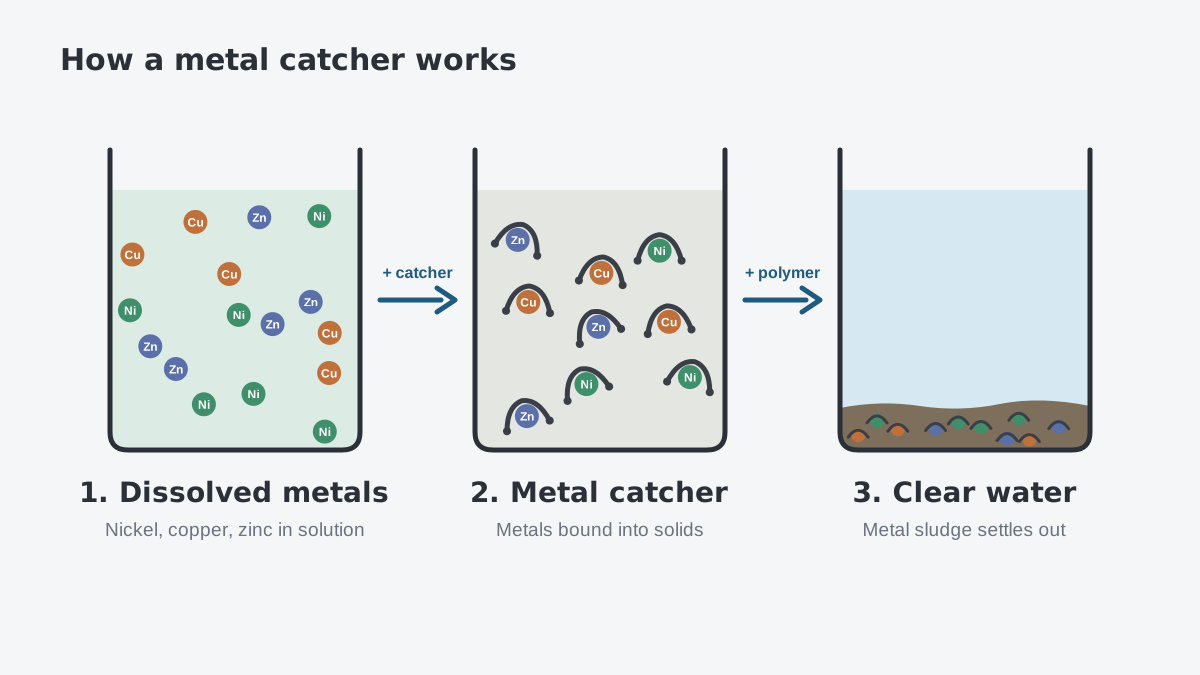
Heavy metals such as nickel, copper and zinc are invisible once they’re dissolved, yet even a fraction of a milligram per litre can put an effluent over its discharge limit. A metal catcher is a chemical that pulls them out of solution. This guide explains how it works, when the usual pH method isn’t enough, and what to watch for.
What is a metal catcher?
“Metal catcher” is a common name for a heavy-metal precipitant: a chemical that binds dissolved metals into solid, insoluble compounds. Once the metals are solid, a polymer gathers them into a coarse floc that settles quickly.[1]
Chemical precipitation is the most common way of treating wastewater that carries metals.[2] The usual method is hydroxide precipitation: an alkali such as caustic soda or lime raises the pH to the point where the metals are least soluble, and they come out as metal hydroxides.[2] A metal catcher takes a different route, binding the metal directly. Two well-studied types are sulphide and xanthate precipitants.[2]
Where are metal catchers used?
Wherever wastewater carries dissolved metals, for example from metal plating.[1] In Malaysia, the limits for industrial effluent are strict. These are the heavy-metal limits from the Fifth Schedule of the Industrial Effluent Regulations:[3]
| Metal | Standard A | Standard B |
|---|---|---|
| Mercury | 0.005 | 0.05 |
| Cadmium | 0.01 | 0.02 |
| Chromium, hexavalent | 0.05 | 0.05 |
| Chromium, trivalent | 0.20 | 1.0 |
| Arsenic | 0.05 | 0.10 |
| Lead | 0.10 | 0.5 |
| Copper | 0.20 | 1.0 |
| Manganese | 0.20 | 1.0 |
| Nickel | 0.20 | 1.0 |
| Tin | 0.20 | 1.0 |
| Zinc | 2.0 | 2.0 |
| Silver | 0.1 | 1.0 |
| Selenium | 0.02 | 0.5 |
| Barium | 1.0 | 2.0 |
Standard A covers discharges in the catchment areas upstream of water supply intakes, and Standard B covers other inland and Malaysian waters.[3] Our guide What is a coagulant? has the full table.
What problems do they solve?
Research on sulphide precipitants shows why they’re used where hydroxide precipitation falls short:[2]
- Lower metal levels. Metal sulphides are far less soluble than metal hydroxides, so more metal is removed.
- A wide pH range. They work from about pH 2 to pH 12.
- Chelated metals. Metals can still be removed with chelating agents present, though the chelating agent still has an effect.
- Metals stay put. Metal sulphides are less likely than hydroxides to dissolve again.
- Less sludge. The sludge is usually smaller in volume and easier to dewater.
Xanthate precipitants share many of these strengths: they are less sensitive to pH and to chelating agents, give a sludge that dewaters better, and can remove some metals selectively. At high metal concentrations they may not be economical, but they can be used as a second step to take the metal below the discharge limit.[2]
What to watch out for
| Watch for | Why it matters |
|---|---|
| Overdosing | Too much precipitant makes treatment less effective.[1] With sulphide types, the excess also risks odour and hydrogen sulphide gas,[2] and sulphide in effluent is itself limited to 0.50 mg/L.[3] |
| Fine particles | Very fine precipitate can settle and filter poorly,[2] which is why a polymer is added to build a coarse floc.[1] |
| Tightly chelated metals | Chelating agents still affect how well metals precipitate.[2] Where they hold on too tightly, they can be broken down first with an oxidiser. See What is an oxidiser? |
| Every wastewater differs | Competing reactions make the right dose impossible to calculate, so it has to be found by jar testing.[1] |
Using a metal catcher
Metal removal is usually a short sequence: the pH is set for the metals being removed, the metals are turned into solids, and a polymer gathers the solids into a floc that settles quickly.[1] The best chemicals, pH and doses depend on the metals and on everything else in the water, so they’re worked out case by case with jar tests.[1]
Related guides
- What is a pH adjuster? covers the pH step.
- What is a flocculant? explains how polymers settle the solids.
- What is an oxidiser? covers breaking down chelating agents.
References
- [1]United States Environmental Protection Agency (2000). Wastewater Technology Fact Sheet: Chemical Precipitation (EPA 832-F-00-018). nepis.epa.gov/Exe/ZyPDF.cgi/P1001QTR.PDF?Dockey=P1001QTR.PDF
- [2]Peters, R. W. and Shem, L. (1993). Separation of Heavy Metals: Removal from Industrial Wastewaters and Contaminated Soil. Argonne National Laboratory, US Department of Energy. www.osti.gov/servlets/purl/6504209-mKij3S
- [3]Environmental Quality (Industrial Effluent) Regulations 2009, P.U.(A) 434/2009, made 12 October 2009 under the Environmental Quality Act 1974 — regulation 11, Fifth Schedule (p. 4031) and Sixth Schedule (p. 4032). Department of Environment Malaysia. www.doe.gov.my/wp-content/uploads/2021/08/Environmental_Quality_Industrial_Effluent_Regulations_2009_-_P.U.A_434-2009.pdf